Conservation
The Fuvahmulah tiger shark study: what the research found
Fuvahmulah went from a diver’s rumour to a documented scientific site because of two peer-reviewed studies published in 2024. One counted the sharks; the other looked inside them. Read together, they explain why this one island holds a place in tiger shark science that nowhere else can match — and this guide walks through both in plain language, with the numbers intact and the papers linked.
The photo-ID study: counting 239 tiger sharks
The first paper — Vossgätter et al., published in Scientific Reports in 2024 — set out to answer a deceptively simple question: how many tiger sharks actually use Tiger Harbour, and how loyal are they to the site? The answer reframed the whole destination.
How they identified individuals
You cannot tag and track hundreds of five-metre predators, so the researchers used the sharks’ own bodies as name tags. Every tiger shark carries a unique arrangement of spots, stripe remnants, fin notches, and scars. By photographing sharks on dive after dive and matching each image against a growing catalogue, the team could tell whether a shark was one they had already logged or a genuinely new individual.
Two tools sharpened the picture. Laser photogrammetry — a pair of parallel laser dots set a known distance apart, projected onto the shark and captured on video — let them measure body length from footage alone, without touching the animal. Video sequences captured behaviour and let multiple frames confirm each identification. A large share of the raw images came from divers and dive centres, a citizen-science contribution the study credits directly.
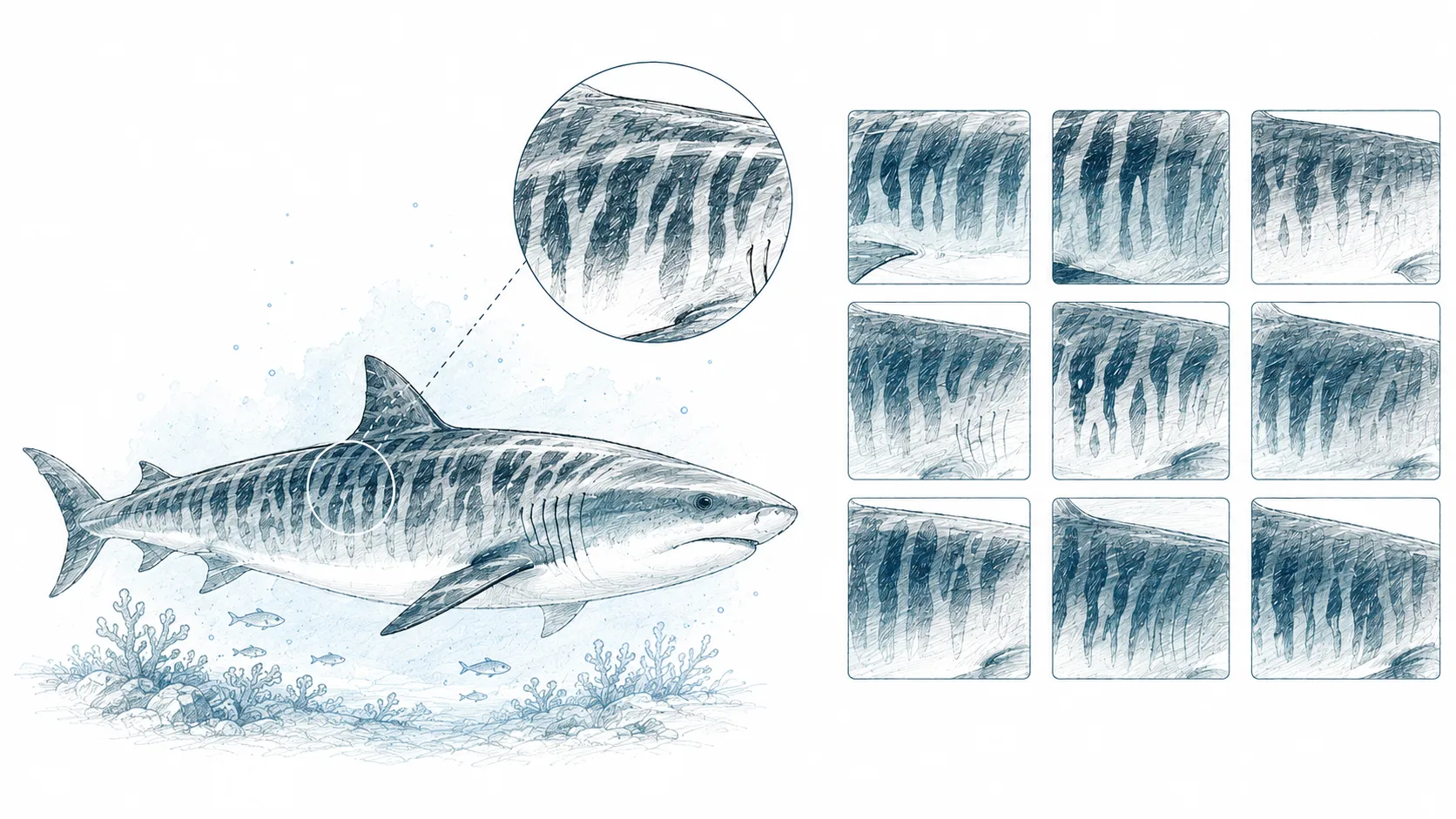
The photo-ID method treats each shark’s stripe pattern, spot field, and scarring as a natural fingerprint.
The 2024 Scientific Reports study (Vossgätter et al.) identified 239 individual tiger sharks at Fuvahmulah’s provisioning site between 2016 and 2023 — the largest documented aggregation of the species in a geographically restricted area. Individuals were told apart by natural markings and measured with laser photogrammetry, a non-invasive method that never requires capturing or tagging the shark.
What they found
The headline count was 239 distinct tiger sharks over the seven-year window. The population was strikingly lopsided by sex — roughly 84.5% female — and dense: dives averaged about 10.4 sharks each, with a remarkable maximum of 40 different individuals encountered on a single 61-minute dive on 21 April 2022.
Most telling was how often the same sharks came back. The overall resighting rate was 77.8%, and 62.8% of individuals were seen across multiple years. When the researchers plotted a lagged identification rate — a statistical measure of how quickly you stop seeing familiar animals — the curve settled onto a plateau that never dropped to zero. In plain terms, a core group of these sharks keeps returning to this one harbour mouth, year after year.
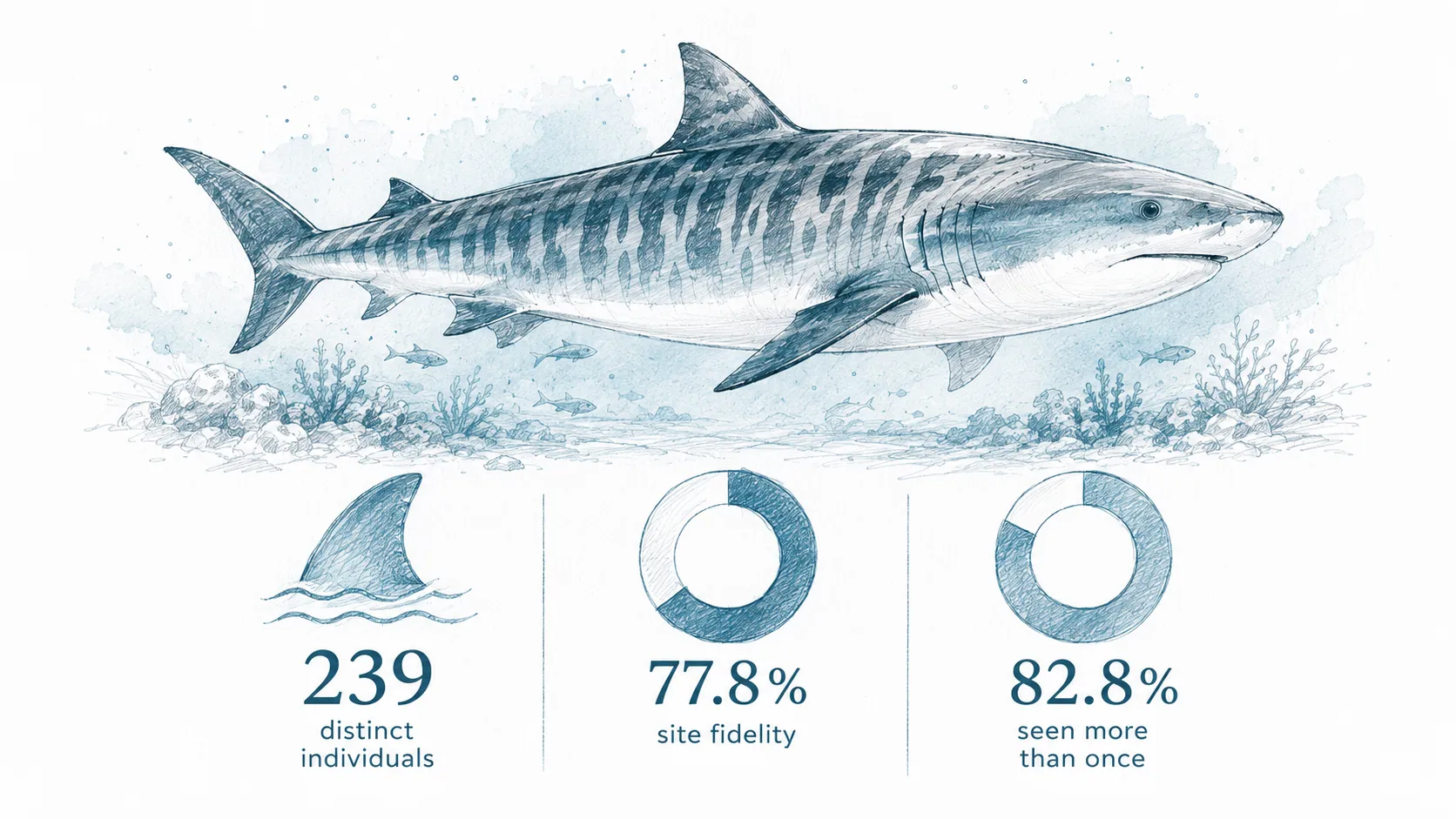
The two numbers that matter most in the first paper are abundance and repeat return: lots of sharks, and many of the same sharks coming back.
Adult female tiger sharks at Fuvahmulah showed strong site fidelity across the study, spending a modelled average of about 60.7 days at the island before departing for roughly 110.4 days and returning. That rhythm of leaving and coming back — rather than staying put or passing through once — is what pointed researchers toward the site playing a specific role in the females’ life cycle.
The study was careful about the provisioning context. The Fuvahmulah dive is a baited, provisioned site, and the authors noted that the Maldives has no laws or binding guidelines regulating provisioned shark dives — the codes of conduct that exist are voluntary and specific to individual dive centres. They called for management modelled on locally managed marine areas elsewhere, rather than reading the aggregation as untouched wilderness. You can read the full paper via its DOI: 10.1038/s41598-024-73079-3.
The ultrasound study: a gestation ground
If the photo-ID study counted the sharks, the second 2024 paper — Sulikowski et al., in Frontiers in Marine Science — asked what all those returning females were doing here. The method was the striking part: submersible ultrasound performed on free-swimming sharks.
Scanning a shark that isn’t caught
Ordinarily, confirming pregnancy in a shark means catching it. At Fuvahmulah the researchers did not have to. Because the sharks are habituated to divers and to a predictable bait point, a diver could hold a waterproof, submersible ultrasound probe against the belly of a large female long enough to image her reproductive tract — no capture, no restraint, no anaesthesia. That non-invasive approach is what made it practical to scan a meaningful sample of adult females rather than one or two unlucky captured animals.
The 2024 Frontiers in Marine Science study (Sulikowski et al.) used submersible ultrasound on free-swimming tiger sharks at Fuvahmulah and found embryos in 26 of 28 adult females scanned — roughly a 93% pregnancy rate, among the highest documented for the species. The authors concluded the site functions as a gestation ground, the first such documented for tiger sharks in the Central Indian Ocean.
What the scans showed
Of 28 adult females examined, 26 carried visible embryos. The scans also picked up two distinct embryo size classes — around 8.0 cm and 18.4 cm in length — which suggests the females present were at different stages of gestation, and hints at a staggered rather than perfectly synchronised breeding schedule across the population.
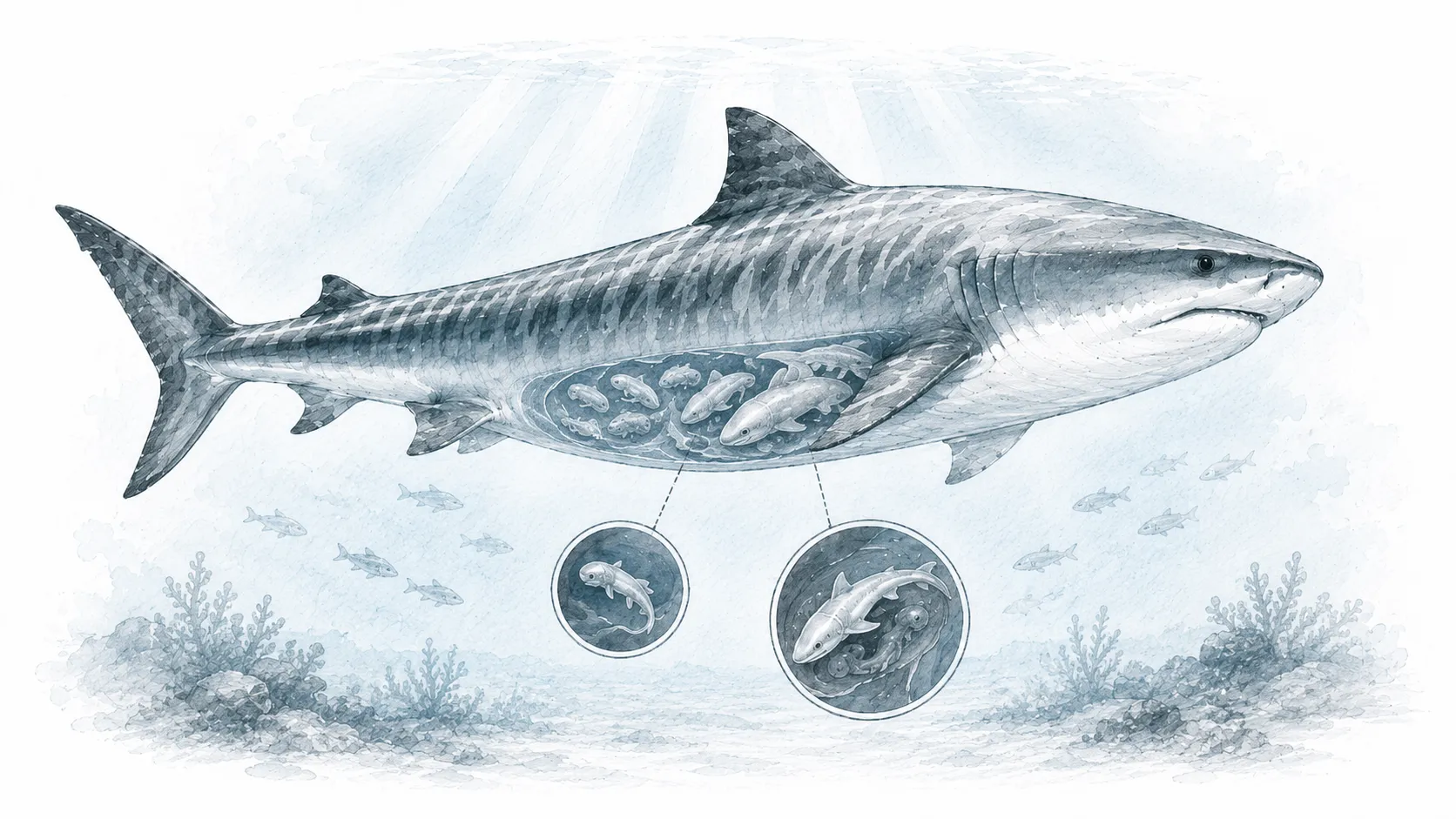
The ultrasound study did not just suggest pregnancy — it visualised embryos directly in free-swimming adult females.
Put beside the photo-ID study’s finding that females leave for roughly 110 days and return, the ultrasound results build a coherent picture: Fuvahmulah is not just a place tiger sharks happen to gather, but somewhere pregnant females come back to through their gestation. That is the basis for calling it a gestation ground — a specific, protectable function, not a general “sharks like it here.” The full paper is at DOI 10.3389/fmars.2024.1500176.
What the research means for divers
For someone planning a dive, the science is not academic trivia — it is the reason the encounter is as reliable as it is. A resident, largely female, frequently pregnant population that returns to a single shallow site explains why sightings feel near-certain year-round in a way they simply are not at other tiger shark destinations.
It also reframes what you are looking at. The large female cruising a metre from your mask is very likely a catalogued individual, quite possibly pregnant, and part of a population that carries real scientific weight — Fuvahmulah’s tiger sharks are the counted, studied core of the reason the island is a UNESCO Biosphere Reserve. The species itself is listed as Near Threatened on the IUCN Red List (assessed 2018, published 2019), with a decreasing global trend, which is what makes a healthy, documented aggregation like this one unusual and worth protecting.
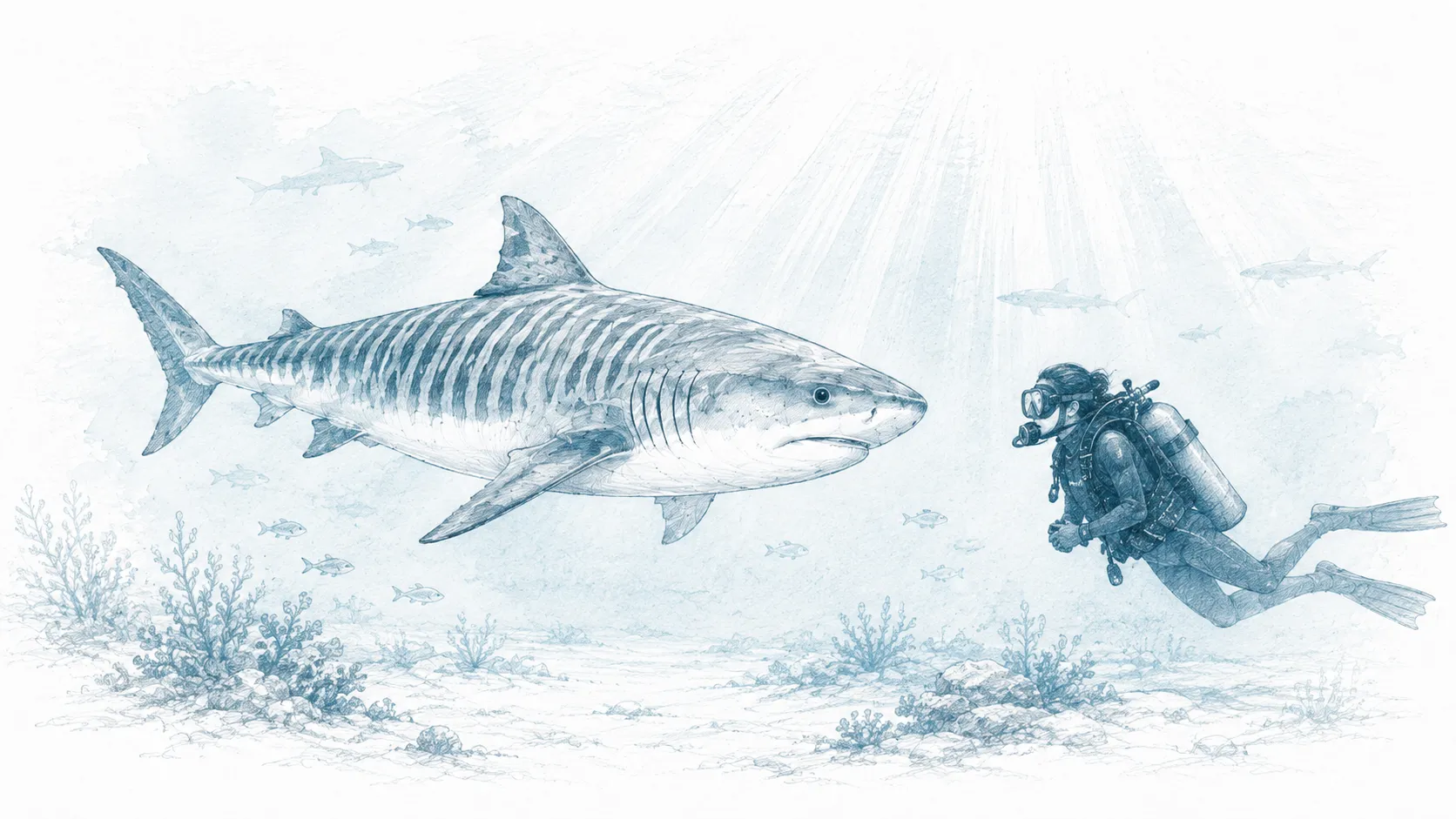
For divers, the science changes the encounter: the shark in front of you is likely a known, repeatedly documented individual, not a random passing sighting.
Tiger sharks (Galeocerdo cuvier) are classified as Near Threatened on the IUCN Red List, assessed in 2018 and published in 2019, with a globally decreasing population trend. Against that backdrop, a documented aggregation of 239 individuals returning to a single Maldivian island — most of them mature, breeding females — is a genuine bright spot, and the reason Fuvahmulah’s research record matters beyond its dive tourism.
Open questions: the science that’s still unfolding
The best measure of how good this research is might be how many fascinating questions it opens rather than closes. Both papers are explicit about what they could not yet answer.
- Where do the females actually give birth? The evidence points to gestation at Fuvahmulah, but no one has yet located the pupping grounds. The photo-ID team specifically recommends satellite telemetry to track pregnant females once they leave the island, and novel intrauterine tags to pin down exact parturition sites.
- Where do they go for those 110 days away? The residency pattern shows females departing for months at a time. Their migratory routes across the Indian Ocean — and whether those routes cross into unprotected waters — remain largely unmapped.
- How does provisioning shape all this? The dive itself is baited, and researchers are still working out how decades of provisioning affect the sharks’ behaviour, health, and aggregation patterns. Work elsewhere suggests provisioning does not obviously restrict tiger shark movements, but the question is unsettled — and, at Fuvahmulah, effectively unregulated.
These are not caveats that weaken the findings; they are the frontier the findings created. Answering them is the next decade of work, and Fuvahmulah — accessible, well-catalogued, and full of returning individuals — is one of the best places on Earth to do it.
Next step: See where all this science actually happens. Read the guide to Tiger Harbour, the harbour-mouth site that is both the dive and the study location.
Frequently asked questions
How do scientists count individual tiger sharks?
By their markings. Every tiger shark carries a unique pattern of spots, stripes, fin nicks, and scars that works like a fingerprint. Researchers photograph each shark, match new images against a catalogue of known individuals, and add genuinely new sharks to the count. Laser photogrammetry — two parallel laser dots of known spacing projected onto the shark — lets them measure body size from video without ever touching the animal.
Are there really 239 tiger sharks in Fuvahmulah?
That is the number of distinct individuals identified over the 2016–2023 study, not the number present on any given day. On a typical dive you might see around ten; the record was 40 different sharks on a single 61-minute dive in April 2022. Because 77.8% of sharks were resighted, many are the same familiar animals returning, so 239 is a running catalogue built over seven years rather than a headcount.
How do you perform an ultrasound on a wild shark?
With a waterproof, submersible ultrasound unit and a lot of trust built through provisioning. At Fuvahmulah the sharks are habituated to divers and to a bait point, so researchers could position a handheld probe against the underside of a large, free-swimming female long enough to image her uterus. It is non-invasive — no capture, no anaesthesia — which is exactly what makes scanning 28 adult females feasible.
Has any new tiger shark research come out since 2024?
The two 2024 papers — the Scientific Reports photo-ID study and the Frontiers in Marine Science ultrasound study — remain the landmark, peer-reviewed record for Fuvahmulah. Both explicitly call for follow-up work using satellite telemetry and hormone analysis to find where pregnant females go to give birth. We track new publications and will update this guide as they appear; as of mid-2026 these two remain the definitive references.
Sources
Sources used on this page
Non-invasive methods characterise the world's largest tiger shark aggregation in Fuvahmulah, Maldives
Open source for Non-invasive methods characterise the world's largest tiger shark aggregation in Fuvahmulah, MaldivesIdentification of the first gestational ground for tiger sharks (Galeocerdo cuvier) in the Central Indian Ocean using a high-definition submersible ultrasound
Open source for Identification of the first gestational ground for tiger sharks (Galeocerdo cuvier) in the Central Indian Ocean using a high-definition submersible ultrasoundGaleocerdo cuvier. The IUCN Red List of Threatened Species 2019: e.T39378A2913541
Open source for Galeocerdo cuvier. The IUCN Red List of Threatened Species 2019: e.T39378A2913541Fuvahmulah Biosphere Reserve, Maldives
Open source for Fuvahmulah Biosphere Reserve, Maldives