Tiger shark diving
Tiger Shark Diving in Fuvahmulah: The Complete Guide
Fuvahmulah offers the world’s most consistent tiger shark diving. Researchers have identified 239 individual tiger sharks at one shallow site, Tiger Harbour, an 8–10 m sand plateau a minute’s boat ride from the island’s harbour. Sightings hold up year-round, and dive packages start from about $1,485 as of July 2026.
That combination — a large, resident, studied population sitting in shallow water next to an inhabited island — does not exist anywhere else. Most tiger shark diving means a boat trip to a remote bank and a real chance of seeing nothing. Here you gear up minutes from the jetty and, on a normal day, share the sand with a line of large sharks cruising past at arm’s length. This guide covers why that happens, how the dive actually runs, who can do it, when to come, what it costs, and the honest story behind the sharks being there in the first place.
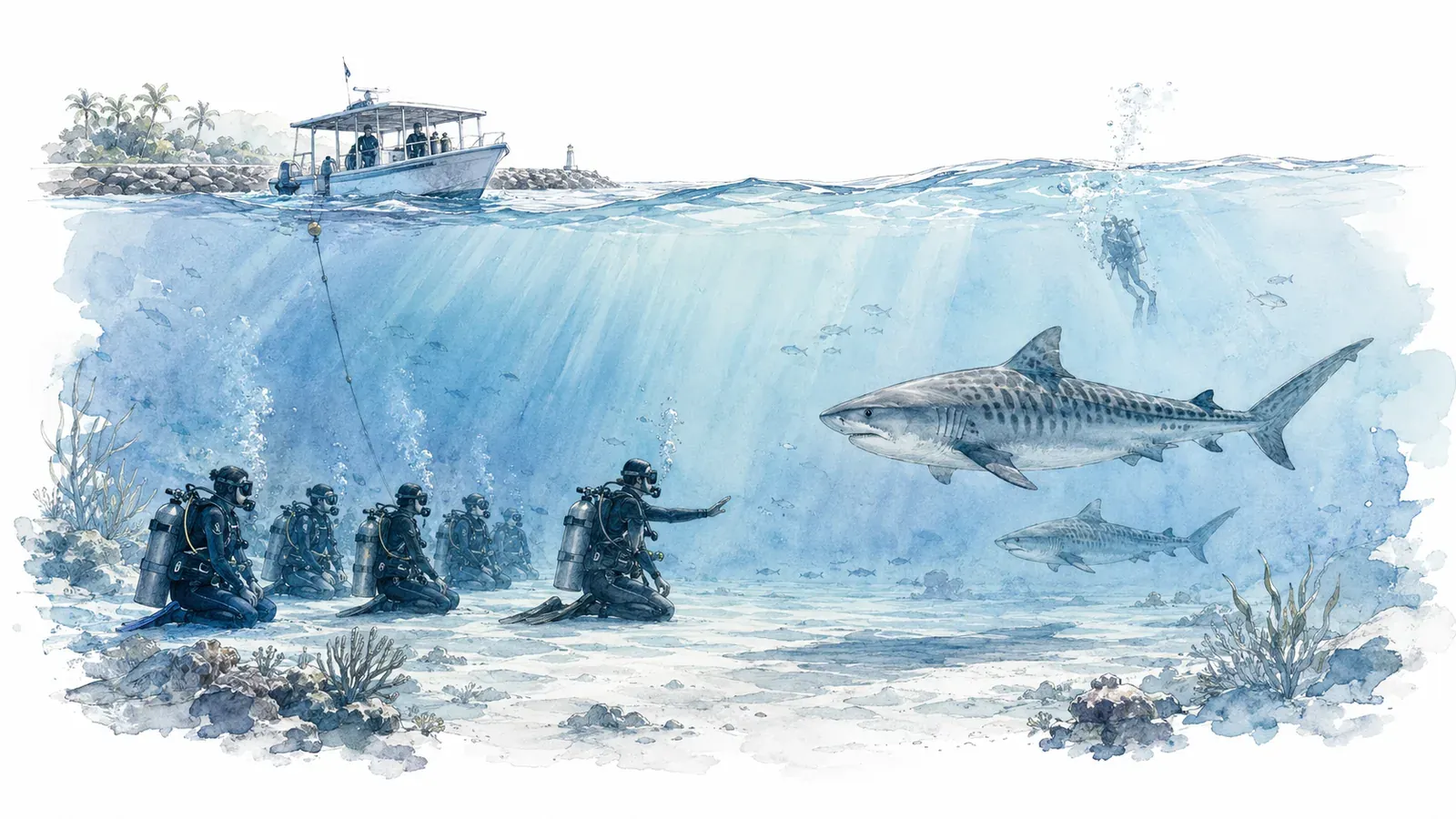
The tiger shark dive is a controlled sequence: short ride, shallow descent, compact group, calm passes, standard ascent.
Why Fuvahmulah and nowhere else
Fuvahmulah is a single island sitting alone in open ocean at the southern end of the Maldives, south of the equator and separated from the rest of the country by deep water. It is not part of a sheltered atoll ring. The reef drops steeply into hundreds of meters of ocean right at the coastline, which pulls oceanic and pelagic species — tiger sharks, threshers, hammerheads, oceanic mantas — close to shore rather than keeping them out in the blue. UNESCO recognized the island’s unusual ecology as a Biosphere Reserve in 2020.
The geography brings the sharks near. What makes them countable, and reliably present, is a well-studied resident aggregation at one spot on the coast.
A 2024 study in Scientific Reports (Vossgaetter et al.) identified 239 individual tiger sharks at Fuvahmulah’s provisioning site from photographs taken between 2016 and 2023. Across that period 77.8% of sharks were resighted on later dives, and surveys recorded an average of 10.4 sharks per dive. No other location has documented a tiger shark aggregation this large or this stable.
Two things make this population scientifically unusual beyond its size. The sharks are overwhelmingly female, and a large share of them are pregnant — a pattern that points to Fuvahmulah being more than a feeding stop.
The same 2024 Scientific Reports study found that 84.5% of identified tiger sharks at Fuvahmulah were female. A companion 2024 study in Frontiers in Marine Science (Sulikowski et al.) used underwater ultrasound and detected embryos in 26 of 28 adult females scanned — the first evidence of a tiger shark gestational ground in the central Indian Ocean.
For a diver, the science translates into something simple: the sharks live here, they come back, and there are a lot of them. That is why operators can run the dive every day of the year and why “did you see any?” is rarely the question — the numbers are.
How Fuvahmulah compares to other tiger shark destinations
Tiger sharks can be dived in a handful of places worldwide, and Fuvahmulah’s distinction is consistency, not exclusivity. The best-known alternatives — Tiger Beach in the Bahamas, Aliwal Shoal in South Africa, and various sites in the Pacific — are genuine tiger shark encounters, but each comes with a trade-off Fuvahmulah largely avoids.
The clearest difference is reliability. At most tiger shark sites the animals are seasonal or transient, so a trip is a gamble on timing and a good week. Fuvahmulah’s aggregation is resident and studied, with the resighting and per-dive numbers to back it up, which is why operators here market year-round diving rather than a season.
The second difference is access. Many tiger shark dives involve a long boat ride offshore or a liveaboard. At Fuvahmulah the site is a minute from the harbour, so you sleep on land, dive from a day boat, and can fit two or three dives into a day without spending it at sea. The third is depth: at 8–10 m the tiger dive is unusually shallow for a big-shark encounter, which means long bottom times and bright water.
None of this makes Fuvahmulah objectively “the best” — that depends on what you want, and other destinations have their own draws. But if your priority is the highest odds of a close, repeated tiger shark encounter with the least logistical friction, the case for Fuvahmulah is strong and, unusually for dive marketing, backed by published data.
How the dive works
The tiger shark dive is a shallow, largely stationary encounter, not a drift or a deep wall dive. It runs at Tiger Harbour, also known locally as Tiger Zoo, a horseshoe-shaped sand plateau just outside the island’s small main harbour.
Tiger Harbour is a sand plateau averaging 8–10 m deep, according to the Fuvahmulah Scuba Club’s ethical-diving guidelines. Because it is shallow, divers get long bottom times well inside no-decompression limits, and the encounter plays out in bright, clear water rather than the low-light gloom of a deep site. The boat ride from the harbour takes about a minute.
A typical dive follows the same shape. After a surface briefing you back-roll in, descend the short distance to the plateau, and settle onto your knees in a compact group along the sand. A guide manages a bait source ahead of the group to concentrate the sharks; large female tiger sharks arrive and circle, passing close to the line of divers.
Guides do the work of keeping the encounter calm. They shepherd the group, watch divers’ blind sides, and reposition everyone quietly if a shark’s body language changes. The dive usually lasts 45 to 60 minutes — the operator code caps tiger-point dives at 45 minutes — and ends with a standard safety stop before you surface a minute from shore. Advanced divers often run nitrox for extra bottom time.
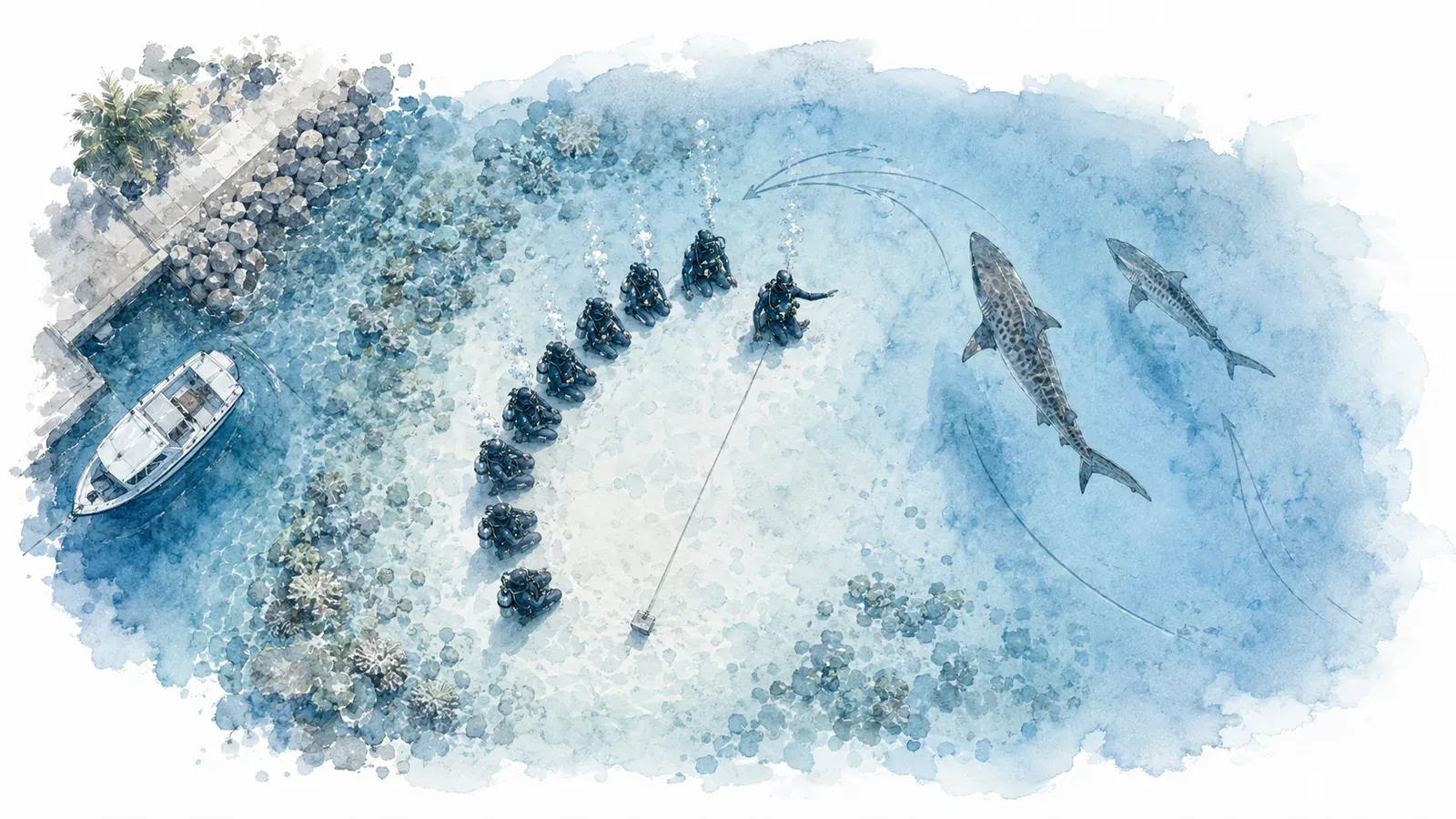
The formation matters: the guide works ahead of the line while divers stay compact, low, and outside the feeding path.
The encounter itself is closer than most people expect. Divers regularly report a dozen or more different tiger sharks on a single dive, and face-to-face proximity — a large shark passing within a meter or two of the line — is the norm rather than a lucky moment. Because you are kneeling on the sand rather than swimming, the experience is less about chasing a sighting and more about holding still while apex predators move through and around the group. Trip reports describe it, almost uniformly, as intense and surreal in equal measure.
It is worth separating the tiger dive from the rest of Fuvahmulah’s diving in your mind. The tiger site is shallow and stationary; the island’s other signature dives are the opposite. Deeper sites use a negative entry and drop to around 30 m for pelagic thresher sharks, scalloped hammerheads, and, in season, oceanic mantas and even whale sharks. A well-planned trip usually pairs the shallow tiger dives with these deeper drop-offs, which is a large part of why Advanced Open Water is the sensible baseline. For a minute-by-minute account of a dive day, see the what-to-expect guide.
Who can do it
Open Water is the floor for the tiger shark dive, but the real answer is “it depends on your operator.” Because the tiger site is shallow, some operators will take a certified Open Water diver straight onto it. Others require Advanced Open Water, or ask Open Water divers to upgrade or complete a short deep-diver course first.
Advanced Open Water is the practical standard for a Fuvahmulah trip, and it is worth having even if your operator would accept less. The island’s other sites — the thresher and hammerhead drop-offs — run to around 30 m and can carry current, so a trip built only around the shallow tiger dive leaves most of Fuvahmulah’s diving off the table.
Certification level aside, the honest limiting factor on the tiger dive is comfort, not depth. You spend the dive kneeling on sand in shallow, clear water, so the skills that matter are calm buoyancy, steady breathing, and the discipline to hold your assigned position while large animals pass close. A nervous diver who bolts or drifts out of the group is a bigger problem than a low logged-dive count. If you are recently certified but comfortable in the water, you are likely fine; if you are certified but rusty, a check-out dive or two before the tiger point is time well spent.
The one written code that exists for the site sets a higher bar than any single operator’s minimum.
The Fuvahmulah Scuba Club’s Guidelines for Ethical Diving at Tiger Shark Point, published September 2025, recommend Advanced Open Water certification plus at least 100 logged dives, cap dive time at 45 minutes, require dark-colored wetsuits, prohibit touching the sharks, and set a ratio of one guide per four divers. It is an operator-issued code, not a government one, but it is the most concrete standard published for the site.
Logged-dive requirements vary: some operators are comfortable with newly certified divers on the shallow dive, while others want to see 30 or more logged dives before the tiger point, and the code above recommends 100. Confirm the number with your operator when you book. The certification requirements guide breaks down what each operator asks for.
A short word on safety, because it is the first thing most people ask. We could find no recorded unprovoked shark bite attributed to Fuvahmulah’s guided tiger shark dive; the documented shark bites in the Maldives have occurred elsewhere and involved baiting or unguided conditions, not this dive. It remains a wild-animal encounter that depends on following the briefing. The safety guide lays out the actual record and how operators manage the risk.
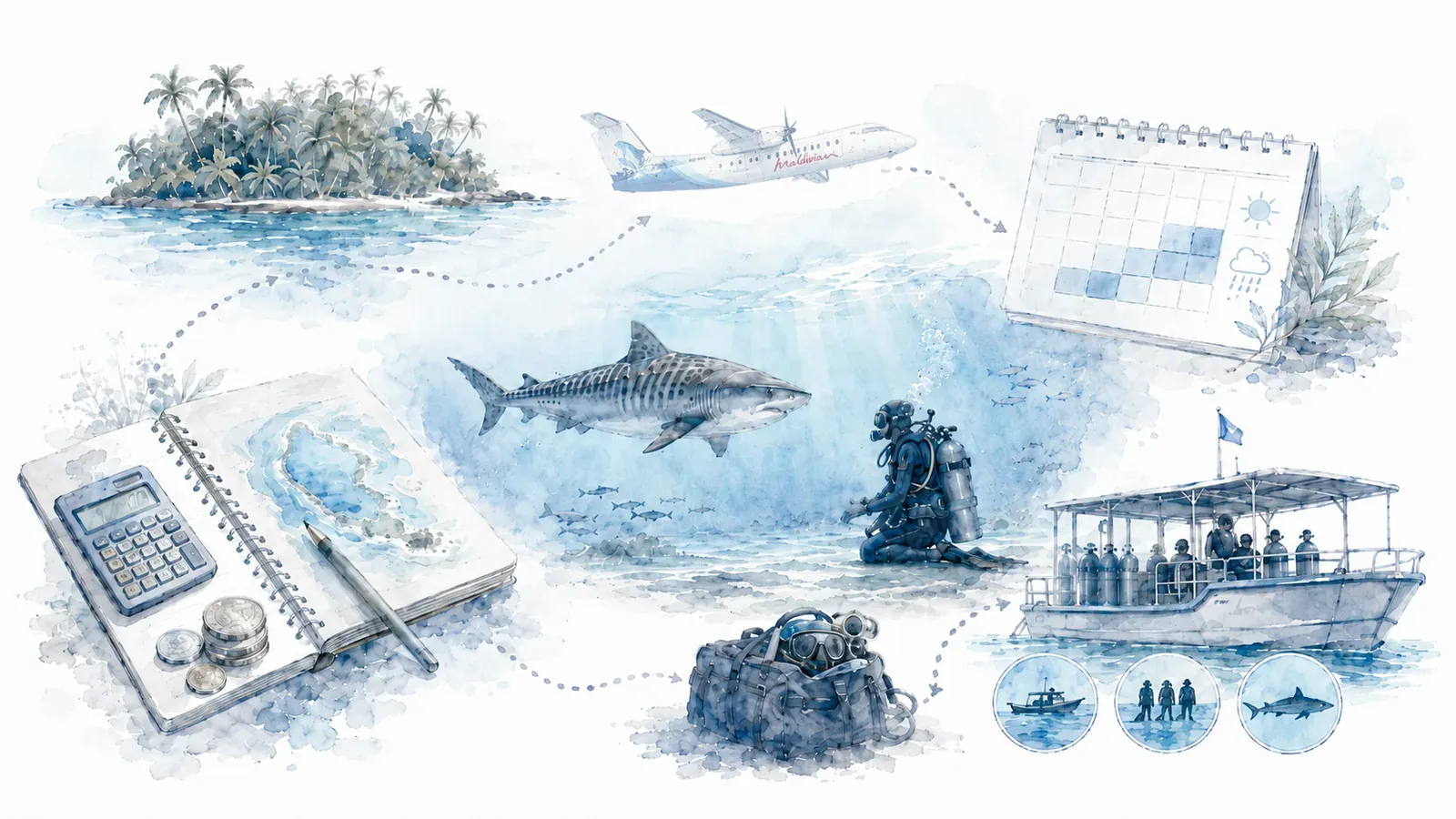
The right planning order is not price first: start with suitability and safety, then season, logistics, budget, and only then operator fit.
When to go
Tiger sharks are at Fuvahmulah every month of the year — that is the whole point of the place, and it is why you can plan a trip around your own calendar rather than a migration window. What changes through the year is the weather, not the sharks.
Roughly December to April is the northeast monsoon: calmer seas, better visibility, and the most comfortable surface conditions for the boat rides. Roughly May to November is the southwest monsoon — wetter, with rougher surface swell and more variable visibility, though still fully diveable and often quieter for bookings. If flat seas and clear water matter to you, aim for the December-to-April window; if budget and space matter more, the shoulder months trade some comfort for lower demand.
For a month-by-month breakdown of conditions and which other species show up when, see the seasonal calendar.
What it costs
Two Fuvahmulah operators publish full package prices; most others quote by WhatsApp or email. The published ladders give a reliable sense of the market. All figures below are per person and current as of July 2026 — treat them as anchors and reconfirm the live rate when you book, since operators adjust prices seasonally.
| Package | Operator | Price (per person) | What it covers |
|---|---|---|---|
| 3 nights / 6 dives | Fuvahmulah Scuba Club | $1,485 | Guided diving, entry-level tiger package |
| 7 nights / 18 dives | Fuvahmulah Scuba Club | $2,920 | A full week of diving |
| 4 nights Fuvahmulah + 3 nights Hulhumalé | Pelagic Divers (Shark Maniacs) | $2,425 | Includes round-trip Malé–Fuvahmulah domestic flights and transfers |
On top of the dive package, the largest fixed extra is the domestic flight from Malé. As of July 2026, Maldivian’s diver fare is about $187.50 one way — roughly $375 round trip — unless your package already bundles it, as the Pelagic Shark Maniacs package does. Then budget for meals, any gear rental, and nitrox fills if you use them.
The costs guide builds this into a full trip budget, and the operators guide lists every active dive center with its published package range and requirements side by side.
How many days to plan
The published packages hint at the sensible range. A 3-night, 6-dive trip is enough to dive the tiger point several times and come away having seen it properly. Most divers who make the journey stay longer — a week of diving lets you repeat the tiger dives, add the deeper thresher and hammerhead sites, and absorb a weather day or a travel delay without losing your whole encounter.
The domestic flight is the reason not to cut it too fine. Schedules can shift, so a trip with only one dive day at the end is exposed if a flight moves. Building in a buffer day before your onward connection is standard advice, and it doubles as insurance against a rough-sea day when the boats stay in. The planning guides walk through the length-versus-budget trade-off in more detail.
The honest story: why the sharks are here
The tiger sharks gather at Tiger Harbour for a reason worth being straight about. The site sits at the mouth of the island’s fishing harbour, and tiger sharks have long congregated there to feed on fish waste discarded by the local fishery — a food subsidy that predates any dive tourism. The 2024 research refers to the location as a “provisioning site,” and that word is doing real work: the aggregation exists partly because of human-supplied food.
Today the dive itself is baited. Guides use a bait source to draw the sharks in and hold them near the group, which is how the encounter becomes close and predictable. This is not a hands-off, purely wild observation, and reputable operators do not pretend otherwise.
Whether that troubles you is a personal call, and it is a fair one to weigh. It is also worth knowing that the same aggregation the provisioning created is what enabled two 2024 studies to photo-identify 239 sharks and discover a gestational ground — findings that now underpin the case for protecting the population. The operator code of conduct exists in part to keep the practice within limits: no touching, dark wetsuits, capped dive times, controlled group sizes. The Tiger Harbour site guide tells the full story of the site and the science done there.
In this guide
This is the pillar page for tiger shark diving in Fuvahmulah. The detail lives in the guides below:
- Is tiger shark diving safe? — the actual record, how operators manage risk, and who shouldn’t do this dive.
- What to expect on the dive — the dive day from briefing to debrief, and what the encounter really feels like.
- Certification requirements — what each operator asks for, and whether your certification qualifies.
- Seasonal calendar — month-by-month conditions and which species show up when.
- Costs and trip budget — package prices, flights, and a full budget worksheet.
- Operators — every active dive center, compared on the same fields.
- Tiger Harbour dive site — the site, its two names, and the research done there.
Next step: most people’s first real question is whether this is safe. Read the tiger shark diving safety guide for the honest record and how the risk is actually managed.
Frequently asked questions
Is tiger shark diving in Fuvahmulah safe?
It is a wild-animal dive run under an established routine: guided groups, controlled depth of 8–10 m, and a briefing on where to sit and how to hold position. We could find no recorded unprovoked shark bite attributed to Fuvahmulah's guided tiger shark dive, and the Maldives' documented bites have happened elsewhere under baited or unguided conditions. See the safety guide for the full record and how operators manage risk.
How deep is the tiger shark dive?
Shallow. Tiger Harbour is a horseshoe-shaped sand plateau averaging 8–10 m, so you spend the encounter within easy no-decompression limits and with plenty of bottom time. Fuvahmulah's other sites run much deeper — drop-offs to 30 m for threshers and hammerheads — but the tiger dive itself is one of the shallowest big-shark encounters anywhere.
What certification do I need to dive with tiger sharks in Fuvahmulah?
Open Water is the floor. Some operators accept certified Open Water divers for the tiger dive; others require Advanced Open Water or an upgrade first. Advanced Open Water is the practical standard, because the island's other sites reach 30 m and can carry current. The operator-issued code of conduct recommends Advanced Open Water plus around 100 logged dives. Confirm the exact requirement with your operator when you book.
When is the best time to dive Fuvahmulah for tiger sharks?
Any month. Tiger sharks are resident year-round, which is what makes the site unusual. The variable is weather: roughly December to April brings the calmest seas and best visibility, while the May-to-November southwest monsoon is wetter with rougher surface conditions. Pick your dates around sea state and budget, not around whether the sharks will show.
How much does tiger shark diving in Fuvahmulah cost?
Published multi-day packages start at about $1,485 per person for 3 nights and 6 dives and run past $2,900 for a week of diving, as of July 2026. On top of the package, budget for the domestic flight from Malé — a diver fare of about $187.50 one way as of July 2026 — plus meals and any gear rental. See the costs guide for a full trip budget.
Can beginners dive with tiger sharks in Fuvahmulah?
If you mean a non-diver, no — you need an entry-level scuba certification first. If you mean a newly certified Open Water diver, sometimes: some operators will take you on the shallow tiger dive, others want Advanced Open Water or a few more logged dives first. The dive itself is shallow and largely stationary, so the limiting factor is comfort and buoyancy control, not depth.
Sources
Sources used on this page
Non-invasive methods characterise the world's largest tiger shark aggregation in Fuvahmulah, Maldives
Open source for Non-invasive methods characterise the world's largest tiger shark aggregation in Fuvahmulah, MaldivesIdentification of the first gestational ground for tiger sharks (Galeocerdo cuvier) in the Central Indian Ocean using a high-definition submersible ultrasound
Open source for Identification of the first gestational ground for tiger sharks (Galeocerdo cuvier) in the Central Indian Ocean using a high-definition submersible ultrasoundFuvahmulah Biosphere Reserve, Maldives
Open source for Fuvahmulah Biosphere Reserve, MaldivesGaleocerdo cuvier. The IUCN Red List of Threatened Species 2019: e.T39378A2913541
Open source for Galeocerdo cuvier. The IUCN Red List of Threatened Species 2019: e.T39378A2913541Guidelines for Ethical Diving at Tiger Shark Point, Fuvahmulah
Open source for Guidelines for Ethical Diving at Tiger Shark Point, FuvahmulahDive packages
Open source for Dive packagesDive packages
Open source for Dive packagesDomestic flight to Fuvahmulah (Maldivian diver fares and baggage)
Open source for Domestic flight to Fuvahmulah (Maldivian diver fares and baggage)Yearly worldwide shark attack summary
Open source for Yearly worldwide shark attack summary