Tiger shark diving
Is tiger shark diving in Fuvahmulah safe?
Tiger shark diving in Fuvahmulah is a wild-animal encounter, and the honest answer to “is it safe?” is the one this page opens with: there is no recorded unprovoked shark bite attributed to the guided tiger shark dive here, but that is the absence of any listed incident, not an official all-clear. It stays a real-risk dive, and what keeps that risk low is structure — a controlled site, a low guide-to-diver ratio, and conduct rules every diver follows. Here is how that actually breaks down, and where the risk really sits.
What does the safety record actually show?
Start with the thing search results get wrong. “No shark attacks in the Maldives” is a claim you will see in operator marketing, and it is false. The Maldives has documented bites: a Maldivian corporal was recorded as the first shark-attack fatality of 2024, bitten on 2 June 2024 near Maavah Island in Laamu Atoll during military training, and the International Shark Attack File also lists the Maldives among countries with a single, non-fatal unprovoked bite in 2025. So the honest frame is not “nothing has ever happened in the Maldives.” It is narrower, and more useful.
No searchable public record — across the International Shark Attack File’s yearly worldwide summaries, dive-media coverage, and diver forums — describes an unprovoked tiger shark bite on Fuvahmulah’s guided tiger shark dive. That is an absence of any listed incident, not a positive clearance: the International Shark Attack File (Florida Museum) does not certify individual dive sites, and no source states one exists here.
That distinction matters because it is the difference between what is true and what is oversold. You can say, accurately, that the documented shark bites in the Maldives happened elsewhere and under different conditions than Fuvahmulah’s guided dive. What you cannot honestly say is that any authority has inspected this dive and pronounced it incident-free. Operators do make “zero incidents on our dives” statements, and some may well be accurate — but they are operator self-claims, not independently verified records, and at least one operator page pairs that claim with the false Maldives-wide “no attacks” line, so treat the marketing with care.
The viral head-bite video was not Fuvahmulah
If you have watched the November 2024 clip of a diver bitten on the back of the head by a tiger shark and come away nervous about Fuvahmulah, it is worth untangling, because the two get conflated constantly. That incident happened on 15 November 2024 at Hulhumalé’s “Shark Tank,” a site near Malé — not Fuvahmulah, which sits roughly 500 km south at the bottom of the country.
The November 2024 Maldives “head bite” occurred at Hulhumalé’s Shark Tank, not Fuvahmulah. Reporting indicates the diver wore a brightly-coloured novelty hood, bait was used (illegal in the Maldives), and the dive was informal and unguided. Fuvahmulah’s tiger shark dive is a different site with a low guide ratio, a dark-wetsuit rule, and a formal code of conduct — the exact conditions the Hulhumalé incident lacked.
The details are the point. A bright, high-contrast hood is precisely what the Fuvahmulah conduct rules prohibit. Bait handled by a diver in the water, rather than managed as a single controlled source by a guide, is a different setup entirely. None of that excuses the risk of diving with large predators — but it does mean the most alarming footage in circulation is not evidence about the dive most people are asking about when they search for Fuvahmulah.
How do operators manage the risk?
The Fuvahmulah tiger shark dive is deliberately un-dramatic in its logistics, and that is the safety story. The site — Tiger Harbour, a horseshoe-shaped sand plateau averaging 8–10 metres deep, a one-minute boat ride from the island’s main harbour — is shallow, sheltered, and predictable. Nobody is drifting a wall at 30 metres hoping to spot a shark. You descend, settle onto the sand in a compact group, and stay put while the guide works.
The conduct rules come from a written document, Guidelines for Ethical Diving at Tiger Shark Point, Fuvahmulah, issued by the Fuvahmulah Scuba Club (an operator, not a government body) and dated 25 September 2025. It codifies what serious operators already run to:
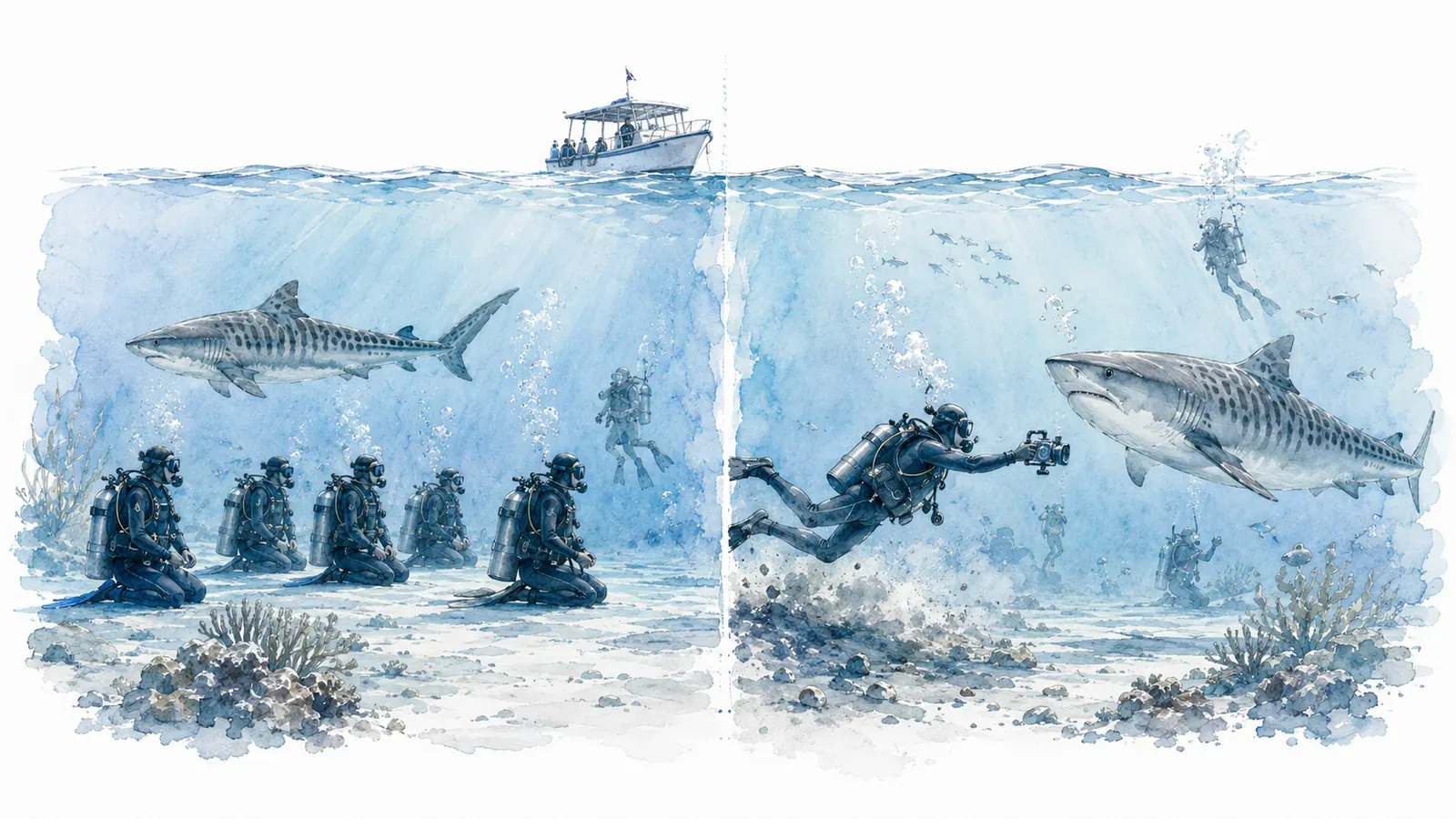
The most important safety visual is simple: stay compact, stay low, and never drift into the shark’s line.
- One guide per four divers. A low ratio means a guide can actually watch each diver and the sharks at once. Small-group operators cap boats at roughly 12–14 guests and keep the same 1:4 ratio in the water.
- A single, guide-managed bait source. The bait draws the sharks to a known point ahead of the group. Divers stay behind and to the side of it, never between a shark and the bait.
- Blind-side cover. Guides actively shepherd the group and watch each diver’s back — the repeated phrase in trip reports is that they “protect you from behind,” repositioning the group calmly if a shark’s approach changes.
- A controlled depth and time. The dive runs at 8–10 m at Tiger Harbour, with a maximum dive time of 45 minutes and a mandatory 5 m / 3-minute safety stop.
- Dark wetsuits, no flashy colours. High-contrast gear and bright novelty items are prohibited — the specific factor flagged in the Hulhumalé incident.
- No touching, no chasing, no camera use on descent or ascent. Cameras stay stowed while you are moving through the water column; hands stay off the animals.
None of this makes the dive risk-free, and no honest operator claims it does. What it does is remove the variables that turn a wildlife encounter into an incident: unpredictable depth, scattered divers, unmanaged bait, and gear that makes you look like prey.
What do tiger sharks actually do around divers?
Tiger sharks at Fuvahmulah behave less like the ambush predators of documentary voiceovers and more like large, curious animals moving through a place they visit often. The population is unusually well-studied: a 2024 study in Scientific Reports identified 239 individual tiger sharks at the provisioning site between 2016 and 2023, found the aggregation to be about 84.5% female, and recorded an average of roughly 10.4 sharks per dive survey. These are, in large part, the same animals returning again and again — the study measured a resighting rate near 78%.
A 2024 study in Scientific Reports (Vossgätter et al.) identified 239 individual tiger sharks at Fuvahmulah’s provisioning site over 2016–2023, with an average of about 10.4 sharks per dive survey and a resighting rate near 78%. This is a habituated, largely resident aggregation of familiar individuals, not a rotating cast of unpredictable transients — which is part of why guides can read the animals so consistently.
In practice, that means the sharks approach. Face-to-face proximity is the norm, not the exception; divers routinely report a dozen or more individuals on a first dive, passing within a metre or two of the line. Large females circle the bait and the group in slow, deliberate loops. This is the dive working as designed — a close pass is not a warning. What a guide watches for is a change: a shark that fixes on the group, angles in directly, or shifts its posture. When that happens, the guide redirects the animal and repositions the divers. The calm you are asked to hold is not bravado; it is the behaviour that keeps you legible to the animal as a static object on the sand rather than something worth investigating.
What’s expected of you?
A lot of the safety margin on this dive is yours to hold up. Operators can control the site, the ratio, and the bait, but they cannot control how you behave once a five-metre shark is a metre from your mask. The rules that fall to you are simple and non-negotiable:
- Wear a dark wetsuit and leave the flashy gear at home. No bright hoods, no dangling high-contrast accessories, no shiny trailing straps.
- Stay in formation on the sand. Settle where the guide places you and hold position. Do not swim toward the sharks, do not drift off the line, and do not put yourself between a shark and the bait.
- Keep the camera stowed during descent and ascent. Manage your buoyancy and your position first; shoot only once you are settled and only if it does not pull you out of the group.
- Do not touch or chase anything. Hands to yourself, always.
- Respect the 45-minute limit and the safety stop. The dive ends when the guide ends it, with a 5 m / 3-minute stop.
- Be honest about your experience. Tell your operator the truth about your certification, your logged dives, and when you last dived. They make the final call on whether you go, and that call is only as good as the information you give them.
That last point does more work than any piece of gear. The dive assumes you can hold a stable position, manage your buoyancy without fuss, and stay calm when a large animal comes close. If you have to think hard about any of those, say so before you get on the boat.
Who shouldn’t do this dive?
The Fuvahmulah tiger shark dive is not for everyone, and the honest filter is worth applying before you book:
- Genuine beginners. The operator code of conduct recommends Advanced Open Water certification and around 100 logged dives. Some centres accept Open Water divers with a deep-dive upgrade, but a diver still working on basic buoyancy and comfort is in the wrong place. Build your experience first.
- Anyone who panics or freezes under stress underwater. If close proximity to a large predator is likely to trigger a bolt for the surface or a loss of position, this dive puts you and the group at risk. That reaction is human and nothing to be ashamed of — it is just information that this is not your dive.
- Divers who won’t follow the rules. The margin here depends on everyone holding formation and staying off the animals. A diver determined to get a closer shot, touch a shark, or freelance their position is the variable the whole system is built to remove.
- Anyone whose medical fitness to dive is uncertain. Be straight with your operator about your health and recent diving. They make the final call, and a shark dive is not the place to find out you were not fit to be in the water.
If you are an experienced diver with steady buoyancy and the discipline to sit still and follow a guide, you are the diver this dive is designed for.
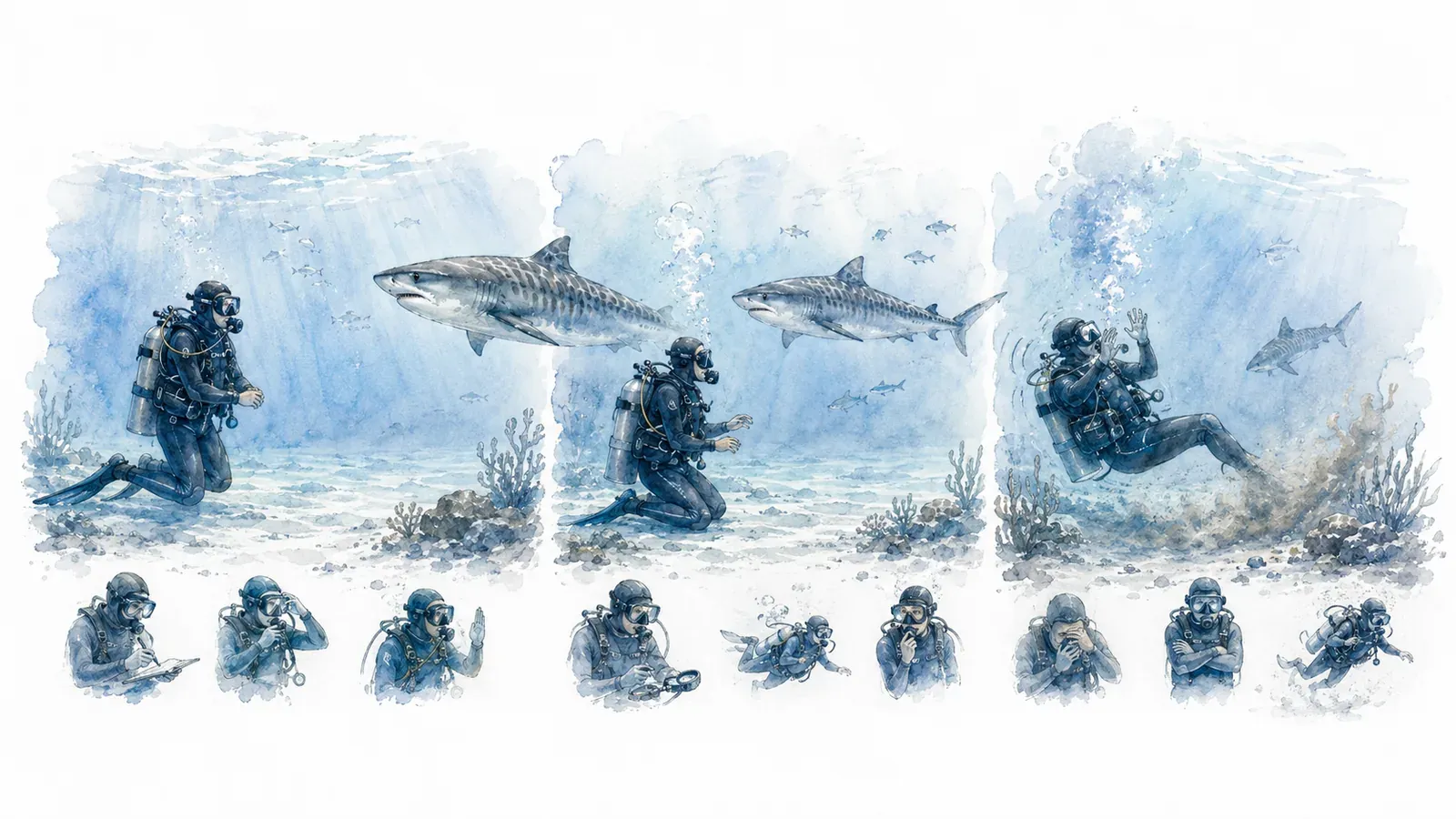
Good fit is mostly about discipline and calm control, not bravado.
Next step: Before anything else, check whether you qualify. Read the certification requirements to see what each operator expects before you book.
Frequently asked questions
Has anyone been bitten on Fuvahmulah's tiger shark dive?
No searchable public record describes an unprovoked tiger shark bite on Fuvahmulah's guided tiger shark dive. That is an absence of any listed incident rather than an official clearance — the International Shark Attack File does not certify individual dive sites. The Maldives as a country does have documented bites, but they occurred elsewhere and under different conditions.
Was the viral Maldives tiger shark head-bite video filmed at Fuvahmulah?
No. The widely-shared November 2024 clip of a diver bitten on the back of the head was filmed at Hulhumalé's 'Shark Tank' near Malé, not Fuvahmulah. Reports say the diver wore a bright novelty hood, bait was used (which is illegal in the Maldives), and the dive was informal and unguided. Search results routinely conflate it with Fuvahmulah; it is a different site and a different set of conditions.
Do tiger sharks get aggressive around the bait?
The sharks are focused and deliberate around a bait source, not frenzied. Guides manage a single bait point ahead of the group, keep divers behind and to the side of it, and reposition everyone calmly if a shark's body language changes. The bait draws the sharks in; the formation keeps you out of the feeding line.
Can beginners dive with the tiger sharks?
It is not a beginner dive. The operator-issued code of conduct recommends Advanced Open Water certification and around 100 logged dives, and most operators expect solid buoyancy and comfort at 8–30 m. Some centres accept Open Water divers with a deep-dive upgrade; confirm the exact requirement with your operator before you book. See the certification-requirements guide for the per-operator picture.
What happens if a shark gets too close?
Close passes are normal — sharks routinely cruise within a metre or two of the line, and that is the dive working as intended, not a warning sign. If a shark angles directly at the group or its posture shifts, the guide steps in, redirects it, and repositions divers. You stay still, stay in formation, and let the guide manage it rather than pushing off or bolting for the surface.
Sources
Sources used on this page
Yearly worldwide shark attack summary
Open source for Yearly worldwide shark attack summaryGuidelines for Ethical Diving at Tiger Shark Point, Fuvahmulah
Open source for Guidelines for Ethical Diving at Tiger Shark Point, FuvahmulahNon-invasive methods characterise the world's largest tiger shark aggregation in Fuvahmulah, Maldives
Open source for Non-invasive methods characterise the world's largest tiger shark aggregation in Fuvahmulah, MaldivesDive packages
Open source for Dive packages